In early 2025, YZi Labs posted this:
The tweet pointed to a Binance Square post from Changpeng Zhao (CZ) that laid out a simple pay-to-reach model: verified KOLs could set a price for inbound messages, payments would run through crypto, no new token was needed, and YZi Labs might invest in a good MVP using BNB or BSC as the primary payment option.
CZ also said he would be a first user if the platform was secure enough.
That gave us a concrete product spec and a narrow window to test whether paid access to high-profile people could work as a product.
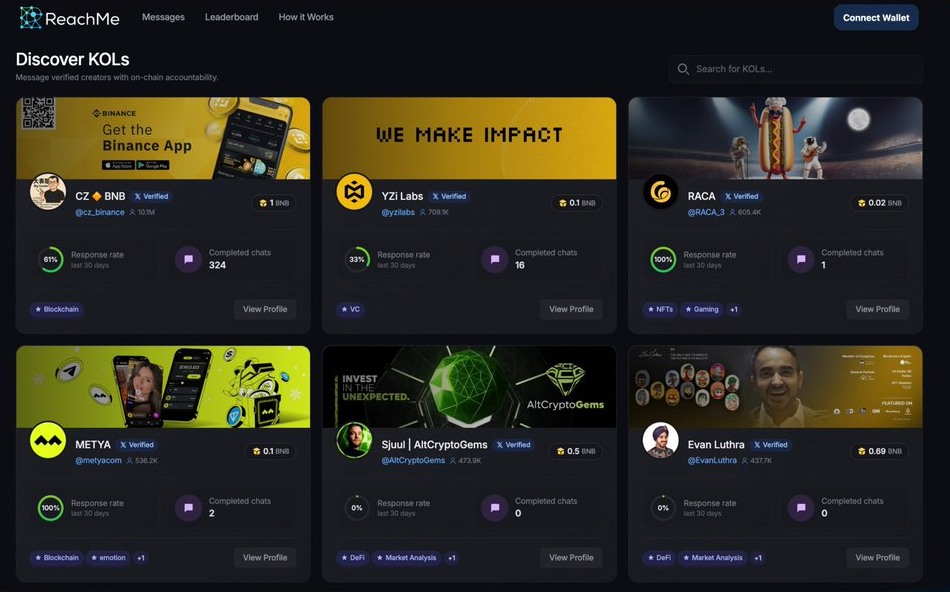
Within hours, we started building. Within roughly 30 hours, we had a working MVP with the essential pieces functioning end to end. Profiles were linked to X accounts so users could confirm who they were paying to reach, the product was integrated with BNB Chain, and the core flow was real: a profile, a price, an on-chain payment, and a direct message.
The goal at that stage was not fundraising or partnership discussions. We wanted to answer a simple question:
Would people actually pay for access if the person on the other side was someone they genuinely wanted to reach?
A few days later, we demonstrated the product to CZ and members of his team. The feedback was positive. The following day I drove from Dubai to Abu Dhabi.
I spent several hours with CZ and a small group of people. Surprisingly little of the conversation was about ReachMe itself.
At the time, he had only recently been released from prison, and much of the discussion revolved around his experiences, what the past year had been like, and his perspective on everything that had happened. It gave us a more direct impression of someone who is usually seen through headlines and public narratives, but it was separate from the product validation we still needed.
Over the following two weeks, the work shifted from demo to launch. That meant security reviews, company formation, infrastructure, payments, compliance, and the operational details that sit between a working MVP and a live product.
By the end of that push, ReachMe was live.
From the original post to launch, the entire process had taken roughly two weeks.
What Happened Next
The launch exceeded our expectations.
People signed up. People paid. Messages were actually being sent.
The core mechanism worked: a high-profile person could set a price for direct access, and users were willing to pay for a credible path to reach them.
The unexpected part was how quickly activity concentrated around a single user.
Internally, we started joking that we should have called the product "ReachCZ" instead of ReachMe.
In theory, ReachMe was a marketplace for attention. In practice, much of the early market revolved around one person.
That created a more useful question than whether payments worked.
The product worked.
The payment flow worked.
The incentives worked.
The open question was whether demand would expand into a broader platform dynamic or stay tied to a small number of highly visible people.
As the initial excitement faded, activity slowed down with it.
I don't consider that a failure.
We had a hypothesis, built quickly, put it in front of real users, and learned from their behaviour. The answer was more nuanced than a simple yes or no: people would pay for attention, but distribution mattered just as much as the marketplace mechanics.
What We Learned
The useful takeaway for me was practical.
Speed changed what we could learn.
If we had spent months planning, ReachMe might have looked better on paper, but it would have been less connected to the moment that created the opportunity.
Building quickly forced us to deal with actual user behaviour instead of debating assumptions. It also made the concentration of attention very obvious. The internet has many channels, communities, and platforms, but a small number of people still command a disproportionate amount of attention.
ReachMe was one of the fastest products I've ever helped build.
The strongest signal wasn't that everyone needs a paid inbox. It was that when access is scarce and the path feels credible, people are willing to pay for it.